Metal fences fail in silence. No dramatic creak or sudden collapse, just slow invisible corrosion, working its way from surface to core, as you go about your day. By the time most homeowners realize there is a serious problem, rust has already eaten through joints and weakened posts, turning what should have been a decade-long investment into a liability. The cruel part? Every week of delay makes the damage exponentially harder and more disruptive to fix.
At Puget Fence Inc., we’ve restored and replaced enough corroded fences across Western Washington to know exactly what ignored rust looks like, and what it costs homeowners who waited too long.
This guide breaks down seven warning signs of rust on a metal fence that demand your attention, explains the science behind why rust spreads the way it does, and tells you exactly what to do before the damage becomes irreversible.
Why Rust on a Metal Fence Is a Serious Problem
The Chemistry Homeowners Don’t Know, But Should
Rust is mostly seen as a surface problem. It isn’t. When iron comes into contact with oxygen and water, it forms iron oxide, which takes up far more space than the metal itself. That expansion causes paint to bubble, joints to crack, and posts to crumble. The rust you see on the surface is always the smallest part of the problem; the real damage is happening underneath, where you can’t see it.
Risks of Untreated Fence Rust
- Structural failure of posts and load-bearing sections
- Sharp, jagged edges create injury risks for children and pets
- Corrosion is spreading rapidly from one section to the entire fence line
- Gate misalignment as hinges deteriorate
- Full fence replacement instead of targeted repair
1. Orange or Brown Discoloration on the Surface
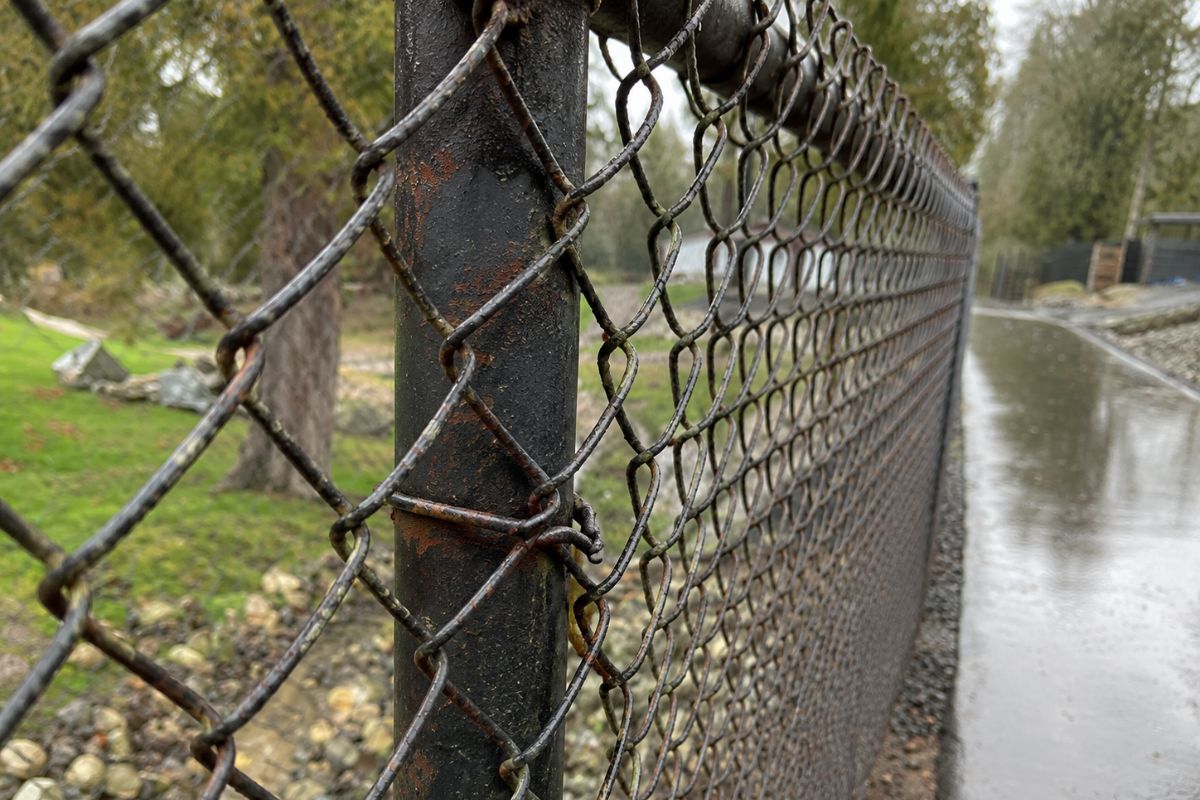
Surface discoloration is the earliest and most actionable of all signs of rust on a metal fence. If you notice orange or brown streaking, oxidation has started, but the metal underneath is still pretty much intact. This is the easiest stage to intervene. Remove the rust, apply a good rust-inhibiting primer, and finish with a protective topcoat.
Most homeowners dismiss this as weathering. That instinct is expensive.
2. Bubbling or Peeling Paint
Peeling paint metal fence rust is not a cosmetic problem; it’s a structural warning. Moisture gets under the paint layer, creates rust underneath, and physically pushes the coating outwards. Those bubbles are a sign of active corrosion going on right now, under the surface you can see.
If you paint over a surface that is bubbling or peeling and don’t treat the rust that is causing the problem, it will return, often more quickly than before. The paint creates a sealed environment that traps moisture and accelerates the very corrosion it is supposed to prevent.
Fast Fact: Rust spreads laterally, not just downward. The corrosion on the surface may be as small as a patch the size of your palm, but underneath the coating it can be three to four times that size.
3. Rough or Flaky Metal Texture
Healthy metal is smooth. If you run your hand over the fence and it’s gritty, layered, or scaly, the metal has started to actively deteriorate. The oxidized layers flake off, exposing fresh metal to the moisture. This ” scaling ” is a positive feedback loop for the fence corrosion, and the more it rains, the faster the fence will corrode.
At this stage, metal fence rust repair requires more than surface treatment. The scaled areas need to be ground back to clean metal before any restoration work can hold.
4. Rust Around Screws, Bolts, and Hinges
Hardware points are the key structural elements and the most overlooked parts of any metal fence. Screws, bolts, and hinges create micro-gaps that allow water to collect and sit. Because dissimilar metals are often present in these areas, the galvanic corrosion can greatly accelerate the process.
What to inspect
- Gate hinges and latch mechanisms
- Post bracket connections
- Exposed bolt heads and caps
- Any joint where two fence sections meet
On a rusted wrought iron fence, decorative joints and ornamental connections are particularly vulnerable. Catching rust here early often means you can repair rusted fence posts and hardware in isolation, before the corrosion migrates into surrounding panels and sections.
5. Weak or Unstable Fence Sections
A wobbly fence, one that leans or feels soft when pressed, is no longer a maintenance issue but a safety issue. Internal corrosion, the kind you don’t see, eats away at metal posts systematically from the inside out, especially at ground level, where soil moisture is ever present.
This is what rust on a metal fence looks like at its most dangerous stage. The fence may look fine visually, but structurally it may be unsound. An internally compromised fence can fail without warning in high wind conditions that are common throughout Western Washington.
A fence that looks fine and fails suddenly is more dangerous than one that looks damaged and stands obviously broken. Never judge structural integrity by appearance alone.
6. Small Holes or Cracks in the Metal
Perforations in metal fence panels mean rust has eaten through the metal all the way through in those areas. The areas around the holes are thin, brittle, and still breaking up. Beyond the obvious security and privacy compromise, these openings accelerate the spread of fence corrosion to adjacent sections by exposing interior metal surfaces directly to moisture and air.
Patching holes without addressing the surrounding corrosion is a short-term fix with a very short lifespan.
7. Rust Returning After Repairs
Recurring rust, coming back within months of treatment, then there are two possibilities. Either the first repair did not completely remove the rust before it was sealed, or the metal has deteriorated so far that it is no longer able to hold a protective coating. Both require a professional assessment, not another do-it-yourself fix.
This cycle of repeated surface treatment is one of the most common and costly mistakes homeowners make when managing warning signs of rust on a metal fence.
How to Prevent Rust on a Metal Fence
Fence rust prevention is not complicated, but it does require consistency. The Pacific Northwest climate, persistent moisture, long rainy seasons, and high humidity create conditions where skipping annual maintenance has real consequences.
What Actually Works
- Inspect twice a year: The critical windows are spring and fall, after the wet season to assess damage, and before it to prepare your fence’s defenses.
- Treat surface rust immediately: The moment you spot discoloration, act. Early-stage rust on a metal fence is a 20-minute fix. Late-stage rust is a replacement conversation.
- Use the right protective coatings: Not all primers and paints are equal. Rust-inhibiting formulas create a chemical barrier, not just a physical barrier. For new installations, powder coating and galvanizing provide the longest-lasting protection.
- Upgrade your hardware: When replacing fasteners, use galvanized or stainless steel. Standard hardware in a wet climate is a known failure point.
| Visual inspection | Twice yearly | Catches problems early |
| Touch-up painting | As chips appear | Stops moisture entry |
| Full repaint + prime | Every 3–5 years | Resets protective barrier |
| Hardware replacement | When corrosion appears | Protects structural joints |
| Professional assessment | If rust returns after repair | Determines repair vs. replace |
Metal fence maintenance tips work best as a routine, not a reaction. Build these steps into your regular home maintenance schedule, and your fence’s lifespan will extend significantly.
Don’t Let Rust Win: Here’s What You Need to Know
The seven fence corrosion signs covered in this guide, from surface discoloration to recurring rust after repairs, all point to the same conclusion: rust on a metal fence is a progressive problem, and every stage you allow it to advance through reduces your options and increases the scope of work required to fix it. Understanding the chemistry of corrosion, knowing where to inspect, and acting at the earliest possible stage are the three things that separate homeowners who maintain their fences from those who eventually replace them.
At Puget Fence Inc., we’ve spent over 20 years working with homeowners across Kitsap, Pierce, Mason, and Jefferson Counties, and we understand exactly what Western Washington’s climate does to metal fencing. Whether you’re noticing the first signs of rust on a metal fence or you’re dealing with sections that are structurally compromised, our team has the expertise to honestly assess your fence, recommend the right course of action, and deliver results that last. We don’t just fix what’s visible; we address what’s causing the problem.
If your fence is showing any of the signs discussed here, don’t wait for a collapsed post or a safety incident to make the call. Reach out to Puget Fence Inc. today for a professional consultation: (360) 509-5095. The sooner you act, the more we can save.